Friday, September 4, 2026

Sell Your Manhattan Beach Home Without Paying Agent Fees


Manhattan Beach is one of the strongest seller's markets in Los Angeles County, which makes it easy to assume a traditional agent-listed sale is the obvious path. But for a growing number of homeowners, the standard 5–6% commission — plus the time, repairs, and uncertainty that come with a conventional listing — no longer makes sense. If your priority is speed, certainty, or simply keeping more of your equity, it's worth understanding the alternative: selling directly to a cash buyer.

This is why so many local homeowners are searching for ways to sell your home fast for cash in Manhattan Beach instead of going the traditional route.

What "Selling Without Agent Fees" Actually Means

When you list with a real estate agent, the standard commission is typically split between the listing agent and buyer's agent — often 5% to 6% of the sale price. On a Manhattan Beach home, where median prices run well into seven figures, that commission alone can total tens of thousands of dollars, on top of closing costs, staging expenses, and any repairs a buyer's inspection turns up.

Selling directly to a cash buyer or investor removes that commission structure entirely. There's no listing agent, no buyer's agent, and in most cases no marketing costs, staging costs, or repair negotiations. The trade-off is usually a sale price somewhat below top-of-market retail value — but for many sellers, the certainty and savings on fees and holding costs offset that difference.

Why Homeowners Search for a Faster Way to Sell in Manhattan Beach

There are a handful of recurring situations where homeowners look for a faster, fee-free way to sell your home fast for cash in manhattan beach:

  • Inherited property. Managing an inherited home from out of state, or splitting proceeds among multiple heirs, is often easier with a quick, straightforward sale.
  • Relocation timelines. A job move or family situation with a hard deadline doesn't always align with a 60–90 day traditional listing and escrow process.
  • Deferred maintenance. Homes that need significant repair work before they'd show well on the open market can be sold as-is to a direct buyer, avoiding renovation costs upfront.
  • Avoiding the showing process. Some sellers simply don't want months of showings, open houses, and negotiations disrupting their household.
  • Financial timing. Sellers facing tight timelines — divorce, probate, or an upcoming purchase elsewhere — often prioritize a guaranteed close date over squeezing out the last few percentage points of sale price.

How the Direct Sale Process Works

For homeowners exploring how to sell my house in Manhattan Beach without listing traditionally, the process generally follows a few consistent steps:

  1. Initial property review. The buyer evaluates the home's condition, location, and comparable sales — often based on a walkthrough or photos rather than a formal appraisal.
  2. Cash offer. A no-obligation offer is presented, usually within days rather than weeks.
  3. Flexible closing. Sellers can typically choose a closing date that works for them, whether that's two weeks out or a couple of months.
  4. As-is sale. No repairs, staging, or inspection contingencies — the home sells in its current condition.
  5. No commission at closing. Because there's no listing agent involved, the commission line item that normally appears on a settlement statement simply isn't there.

Reeland Investments works directly with Manhattan Beach homeowners through this exact process, buying homes as-is and closing on a timeline the seller sets — without the commission structure of a traditional listing. Homeowners weighing their options can get a no-obligation property evaluation directly at Reeland Investments.

Is a Cash Sale Right for Every Manhattan Beach Homeowner?

Not necessarily — and a transparent buyer should tell you that upfront. If maximizing sale price is the only priority and there's no time pressure, a well-marketed traditional listing in a market like Manhattan Beach can still bring in a higher final number after fees. But if speed, certainty, or avoiding repair and staging costs matter more than squeezing out every last dollar, a direct sale is worth comparing side by side.

Homeowners who search for options to sell my home Manhattan Beach should ask any potential buyer for a written, no-obligation offer, a clear closing timeline, and references from past sellers before committing. A company like Reeland Investments that's willing to walk through both the cash-sale and traditional-listing numbers side by side, rather than just pushing for a signature, is generally the safer partner to work with.

Getting Started

If you're trying to figure out the fastest, most cost-effective way to sell a home in Manhattan Beach, the first step is simply getting a real number to compare against a traditional listing. There's no cost or obligation to request an offer, and having that figure in hand makes it much easier to decide which path actually makes sense for your situation and timeline.

Frequently Asked Questions

How fast can I actually sell my house in Manhattan Beach for cash?

Most direct cash sales close in 2 to 4 weeks, and some can close in as little as 7–10 days if the seller needs an expedited timeline. This is significantly faster than a traditional sale, which typically takes 60–90 days from listing to close.

Do I need to make repairs before selling my home in Manhattan Beach this way?

No, Homes are purchased as-is, which means no repairs, no staging, and no need to address deferred maintenance before closing. This is one of the main reasons homeowners with older or unrenovated properties look into this option.

Will I get less money selling without an agent compared to a traditional listing?

Often the upfront offer is below full retail market value, but once you factor in the agent commission (typically 5–6%), closing costs, repair costs, and months of carrying costs (mortgage, taxes, utilities) during a traditional sale, the net difference is often smaller than it appears. It's worth comparing both numbers directly.

Is selling my house fast in Manhattan Beach for cash legitimate, or is it a scam?

Direct home sales are a legitimate and common part of the real estate market, but not every buyer operates transparently. Look for a company willing to provide a written offer, a clear closing process, and references or past transaction history before signing anything.

What types of situations make a cash sale a good fit in Manhattan Beach?

Inherited properties, homes needing significant repairs, tight relocation timelines, probate or divorce situations, and sellers who simply want to avoid showings and open houses are the most common scenarios where a direct cash sale makes sense over a traditional listing.

Monday, August 31, 2026

New Builds With Subterranean Basements and Rooftop Decks Manhattan Beach

Manhattan Beach is one of the most land-constrained markets in Los Angeles County, and that scarcity has pushed new construction in a distinct direction: building down and building up. Rather than expanding outward on already-tight lots, many of today's buy new construction homes in Manhattan Beach are maximizing square footage through subterranean basements below grade and expansive rooftop decks above the main living space.

For buyers and homeowners considering a new build in this market, understanding why these two features have become so central to modern Manhattan Beach design can help clarify what to look for — and why they add so much value.

Why Manhattan Beach Lots Demand Creative Solutions

Manhattan Beach lots are famously small relative to the value of the land beneath them. Height restrictions, strict setback requirements, and a limited buildable footprint mean that traditional single-story or even standard two-story layouts often leave significant square footage on the table. For homeowners who want the space and amenities of a true luxury property, builders have had to get creative with the vertical dimension — both below and above ground.

This is exactly why subterranean basements and rooftop decks have become defining features of new construction in the area, rather than optional upgrades.

The Case for Subterranean Basements

Reclaiming Square Footage Without Expanding the Footprint

A subterranean level allows homeowners to add substantial living space — home theaters, gyms, wine cellars, additional bedrooms, or garage parking — without impacting the home's above-ground footprint or violating height restrictions.

Ideal for Specialty Rooms

Basements are particularly well suited to spaces that don't need natural light or ocean breeze: media rooms, wine storage, home offices, or soundproofed music and recording spaces. This lets the above-ground floors stay focused on the rooms where light and views matter most.

Engineering Considerations

Because Manhattan Beach sits close to the coast, subterranean construction requires careful attention to water table levels, waterproofing systems, and soil conditions. A basement built without the right waterproofing strategy can become a costly, ongoing problem, which is why experienced structural engineering and a builder familiar with coastal soil conditions are essential for this type of work.

The Case for Rooftop Decks

Capturing Views That Ground-Level Space Can't

With ocean views often blocked by neighboring homes at street level, rooftop decks give homeowners direct, unobstructed access to coastal views, sunsets, and ocean breeze that lower floors simply can't offer.

Expanding Usable Outdoor Space

On a small lot, a traditional backyard is often limited. A rooftop deck effectively creates an entirely new outdoor living zone — ideal for entertaining, lounging, or even an outdoor kitchen — without sacrificing any interior square footage.

Design Integration

The best rooftop decks are designed as a true extension of the home's living space, not an afterthought. This often includes retractable shade structures, built-in seating, fire features, and glass railings that preserve the view while meeting safety code.

What to Look for When Buying New Construction

If you're searching for new construction homes for sale in Manhattan Beach that include these features, a few things are worth evaluating carefully:

  • Waterproofing and drainage systems for any subterranean level, along with documentation of the engineering approach used
  • Structural support and load calculations for rooftop decks, particularly if outdoor kitchens or heavy features like spas are included
  • Permitting history — confirm that basement and rooftop additions were fully permitted and inspected, not added informally
  • Natural light solutions for below-grade spaces, such as light wells or window wells
  • Access and circulation, since a well-designed home integrates the basement and rooftop levels smoothly into the overall floor plan rather than treating them as isolated add-ons

Why Buyers Are Prioritizing These Features

For buyers comparing new construction homes for sale Manhattan Beach, subterranean basements and rooftop decks have shifted from a "nice to have" to a near-expectation in the luxury segment of this market. They represent the most effective way to maximize both function and lifestyle value on a lot that can't grow outward, and homes without these features often feel comparatively limited by today's standards.

How Reeland Investments Approaches These Builds

At Reeland Investments, our approach to new construction homes Manhattan Beach starts with understanding how a lot's constraints — and its opportunities — should shape the design. Subterranean levels and rooftop decks aren't features we add as an afterthought; they're planned from the earliest structural and engineering conversations, so the transitions between below-grade, ground-level, and rooftop spaces feel intentional rather than pieced together.

For buyers who want to new construction homes in Manhattan Beach with these features done correctly — with proper waterproofing, structural integrity, and thoughtful design — working with a builder who has direct experience with this specific type of coastal construction makes a meaningful difference in the finished result.

Final Thoughts

In a market where lot size can't expand, smart vertical design is what separates an average new build from an exceptional one. Subterranean basements and rooftop decks aren't just trend features — they're practical solutions to the real constraints of building in Manhattan Beach, and when executed well, they dramatically increase both the livability and long-term value of a home.

If you're exploring new construction options in Manhattan Beach and want a builder who understands how to make the most of a challenging lot, Reeland Investments is happy to walk you through what's possible for your specific property.

Friday, August 21, 2026

Capital Gains Tax on Selling an Ultra-Luxury Home in Beverly Hills: What Sellers Need to Know

Beverly Hills consistently ranks among the most expensive residential markets in the country, with ultra-luxury properties regularly trading well above $10 million. At that price point, capital gains tax becomes one of the most significant financial considerations in the entire sale — often outweighing commission and closing costs combined.

If you're a homeowner thinking, "I need to sell my house in Beverly Hills," understanding how capital gains tax applies to your specific situation is essential before you list. This isn't tax advice — every seller's situation is different, and you should consult a CPA or tax attorney before making decisions — but here's a general overview of how these taxes typically work for high-value California properties.

How Capital Gains Tax Works on a Home Sale

Capital gains tax applies to the profit made on the sale of an asset — in this case, the difference between what you paid for the home (plus qualifying improvements) and what you sell it for. For most homeowners, the calculation involves:

Sale Price − (Original Purchase Price + Cost of Improvements + Selling Costs) = Capital Gain

This gain is then taxed at either short-term or long-term capital gains rates depending on how long the property was held.

Federal Capital Gains Rates

  • Properties held longer than one year typically qualify for long-term capital gains rates, currently up to 20% federally for high earners
  • An additional 3.8% Net Investment Income Tax (NIIT) often applies to high-income sellers
  • Properties held less than a year may be taxed at ordinary income rates, which can be significantly higher

California State Capital Gains Tax

California does not offer a preferential rate for long-term capital gains the way federal law does. Gains are taxed as ordinary income at California's state rates, which can reach 13.3% for top earners — meaning a Beverly Hills seller could realistically face a combined federal and state capital gains burden approaching 33–37% on a large gain.

The Primary Residence Exclusion

For homeowners selling a primary residence, the IRS offers a valuable exclusion:

  • $250,000 exclusion for single filers
  • $500,000 exclusion for married couples filing jointly

To qualify, the seller generally must have owned and lived in the home as a primary residence for at least two of the last five years. For most Beverly Hills sellers, though, given the price points involved, this exclusion covers only a small fraction of the total gain on an ultra-luxury sale.

Why This Matters So Much in Beverly Hills

Because home values in this market have appreciated dramatically over decades, many longtime homeowners face capital gains that far exceed typical exclusion limits. A home purchased in the 1990s for $2 million and sold today for $15 million could generate a gain well over $10 million — a tax liability that can easily reach seven figures once federal, state, and NIIT obligations are combined.

This is one of the biggest reasons sellers exploring how to sell my house Beverly Hills start the planning process months or even years before listing, working closely with tax professionals to structure the sale in the most efficient way possible.

Strategies Sellers Commonly Explore

While every situation requires individualized professional advice, homeowners in this position often research strategies such as:

1. 1031 Exchanges

For investment properties (not typically applicable to primary residences), a 1031 exchange allows sellers to defer capital gains tax by reinvesting proceeds into another qualifying property.

2. Installment Sales

Structuring a sale so proceeds are received over multiple years can sometimes help manage the tax impact by spreading the gain across tax years.

3. Timing the Sale

Some sellers strategically time a sale around other income events, retirement, or relocation to a lower-tax state to reduce their overall tax bracket in the year of sale.

4. Documenting Capital Improvements

Every dollar spent on qualifying renovations and improvements over the years of ownership increases the cost basis, which directly reduces the taxable gain — making thorough records essential.

Weighing Timeline Against Tax Planning

For sellers who need to move quickly — due to relocation, an estate sale, or a change in financial circumstances — there's often tension between waiting to optimize a tax strategy and needing certainty sooner. Some homeowners specifically look for ways to sell my house fast Beverly Hills while still coordinating closely with their tax advisor to understand the net proceeds either way.

Reeland Investments: Working Alongside Your Tax Strategy

Reeland Investments works with Beverly Hills homeowners who are navigating exactly this kind of decision — balancing the desire for a fast, certain sale against the tax and financial planning considerations that come with an ultra-luxury property. For sellers who want to sell your home fast for cash in Beverly Hills, working with a team that understands the unique pressures of high-value transactions can simplify a process that often feels overwhelming.

Whether you're weighing a traditional listing against a more direct path, Reeland Investments can help sellers understand their timeline options — while your CPA or tax attorney handles the specifics of your capital gains exposure. The two conversations should happen in parallel, not in isolation, since your sale strategy directly affects how and when your tax liability comes due.

Questions to Bring to Your Tax Advisor

Before listing your home, it's worth discussing the following with a qualified professional:

  1. What is my actual cost basis, including all documented improvements over the years?
  2. How much of my gain will qualify for the primary residence exclusion, if any?
  3. Would spreading the sale across tax years meaningfully reduce my liability?
  4. How does my state of residency at the time of sale affect my total tax burden?
  5. Does my timeline allow for strategic tax planning, or do I need to prioritize certainty and speed?

Final Thoughts

Capital gains tax is often the single largest cost associated with selling an ultra-luxury home in a market like Beverly Hills, and the difference between a well-planned sale and a rushed one can amount to hundreds of thousands — or millions — of dollars. While this overview provides a general framework, every seller's situation is unique, and professional tax guidance is essential before finalizing a sale strategy.

For homeowners who've decided that speed and certainty matter more than a prolonged traditional listing process, Reeland Investments offers a direct path worth exploring alongside your tax planning conversations. Whatever route you choose, understanding the full tax picture upfront is the best way to make sure you keep as much of your equity as possible when you decide to sell my house Beverly Hills.

Monday, August 17, 2026

Are New Construction Homes in Beverly Hills Worth the Investment?

Beverly Hills has always been synonymous with luxury, prestige, and long-term real estate value. But in recent years, a growing number of buyers are asking a more specific question: are new construction homes in Beverly Hills actually a smart investment, or is the premium price tag just paying for a shiny facade?

If you're weighing whether to buy new or renovate an older property in this iconic zip code, this guide breaks down the real pros, cons, and financial logic behind purchasing new construction homes for sale in Beverly Hills — so you can make a decision backed by more than just curb appeal.

Why Beverly Hills Real Estate Keeps Outperforming

Beverly Hills isn't just a neighborhood — it's a brand. Limited land, strict zoning, celebrity cachet, and consistent global demand have kept property values climbing for decades, largely insulated from the volatility seen in other markets. When you buy here, you're not just buying a house; you're buying scarcity.

This is exactly why new construction homes beverly hills buyers are targeting tend to hold their value exceptionally well. New builds combine that inherent land scarcity with modern design, giving owners a rare mix of appreciation potential and everyday livability.

The Case for Buying New Construction

1. Modern Design Commands a Premium

Today's luxury buyers expect open floor plans, floor-to-ceiling glass, smart-home integration, wellness amenities (think home gyms, spas, and cold plunge pools), and energy-efficient systems. Older Beverly Hills estates often require expensive retrofits to compete — new builds come with all of this baked in from day one, which directly supports resale value.

2. Lower Maintenance, Lower Risk

Older homes in this area, even architecturally significant ones, often hide costly surprises: outdated electrical systems, plumbing issues, foundation concerns, or code violations. New construction homes for sale beverly hills buyers are choosing typically come with builder warranties, updated systems, and far fewer unknowns — a meaningful advantage for investors who don't want ongoing renovation headaches eating into their returns.

3. Stronger Rental and Resale Appeal

Whether you plan to live in the home, rent it out, or flip it in a few years, move-in-ready modern properties consistently attract more interest and higher offers than dated homes needing work. Buyers today — especially in the ultra-luxury segment — are often willing to pay more to avoid the time, cost, and stress of renovation.

4. Customization at the Ground Floor

Purchasing pre-construction or early in the build process can allow buyers to select finishes, layouts, and upgrades — something that's simply not possible with an existing resale home. This flexibility can also translate into smarter, more targeted investment choices tailored to what the current market wants.

What to Watch Out For

New construction isn't automatically a guaranteed win. A few things worth considering before you commit:

  • Premium pricing: New builds typically carry a higher price per square foot than comparable older homes, so your entry cost is higher.
  • Builder reputation matters: Not all developers deliver the same quality. Research the builder's track record, past projects, and reviews before signing anything.
  • Market timing: Like any real estate purchase, timing your buy relative to interest rates and local inventory levels can significantly affect your returns.
  • Location within Beverly Hills: Even within this prestigious zip code, street, school zone, and proximity to Rodeo Drive or the flats can meaningfully impact appreciation.

This is where working with a team that understands both new development and long-term investment strategy becomes essential — not just an agent who can unlock a door.

Is It Worth the Investment? The Verdict

For most buyers, new construction homes in Beverly Hills represent a strong long-term investment — provided you buy in the right location, from a reputable builder, and at a price that reflects fair market value rather than pure hype. The combination of modern amenities, lower near-term maintenance risk, and consistent buyer demand in Beverly Hills gives new builds a real edge over comparable older properties.

That said, investment success ultimately comes down to strategy, not just the age of the property. That's where having an experienced partner on your side makes all the difference.

How Reeland Investments Can Help

At Reeland Investments, we specialize in helping buyers evaluate whether to buy new construction homes in Beverly Hills or pursue other opportunities in the luxury market. Our team analyzes builder quality, location-specific appreciation trends, and long-term ROI potential so you're not just buying a beautiful home — you're making a sound financial decision.

Whether you're a first-time luxury buyer or a seasoned investor expanding your portfolio, Reeland Investments can walk you through current listings, upcoming developments, and off-market opportunities across Beverly Hills.

Final Thoughts

New construction homes in Beverly Hills offer a compelling mix of modern design, reduced maintenance risk, and strong resale appeal — but like any investment, the details matter. Location, builder reputation, and market timing all play a role in whether a new build truly pays off.

If you're exploring new construction homes for sale in Beverly Hills and want expert guidance on making the right move, reach out to the team at Reeland Investments to discuss your options and find a property that fits both your lifestyle and your investment goals.

Thursday, August 13, 2026

New Construction Homes for Sale in Manhattan Beach: 2026 Buyer's Guide

Manhattan Beach remains one of the most competitive luxury housing markets in the South Bay, and new construction continues to reshape its streets one lot at a time. For buyers comparing a move-in-ready older home against a ground-up build, 2026 is shaping up to be a year defined by tight inventory, rising land values, and a steady stream of architect-driven new builds from local developers. This guide answers the questions buyers ask most often about new construction in Manhattan Beach, from pricing to neighborhood breakdowns to what to budget for beyond the sale price.

What Are the Best New Construction Homes for Sale in Manhattan Beach?

The strongest new construction listings in Manhattan Beach tend to share three traits: a walkable location within the Sand Section or Tree Section, an architect of record with a track record in the South Bay, and finishes that hold up against the city's competitive resale market. Buyers should look for homes built by developers who are also licensed contractors, since that combination typically means tighter oversight from permitting through final inspection.

Firms like Reeland Investments approach new construction homes for sale in Manhattan Beach differently than a typical spec builder. Rather than mass-producing a template design across multiple lots, Reeland focuses on a smaller number of architecturally distinct homes across Manhattan Beach, Hermosa Beach, and Redondo Beach, with attention to how each home fits its specific street and lot. That kind of project-by-project approach is one reason buyers increasingly ask their agent specifically about Reeland-built homes when they start touring new construction in the area.

How Much Do New Construction Homes Cost in Manhattan Beach?

New construction pricing in Manhattan Beach varies significantly by section and lot size, but buyers should generally expect a starting range in the low-to-mid $3 millions for smaller Tree Section builds, climbing well past $5–6 million for larger Sand Section homes with ocean views or proximity to the Strand. Price per square foot for new builds typically runs meaningfully higher than resale homes in the same neighborhood, reflecting current land costs, construction pricing, and permitting timelines.

Three factors move the needle most on price:

  • Lot location Sand Section walk-street lots command the steepest premiums.
  • Square footage and lot coverage of larger homes on standard 30x90 lots are priced differently than corner or oversized lots.
  • Finish level builder-grade finishes versus fully custom cabinetry, imported stone, and integrated smart-home systems can shift the final price by hundreds of thousands of dollars.

Which Manhattan Beach Neighborhoods Have the Most New Construction?

New construction activity is concentrated in a handful of Manhattan Beach neighborhoods:

  1. Tree Section has the highest volume of new builds, thanks to a larger inventory of older homes being torn down and rebuilt on tree-lined streets east of Sepulveda.
  2. Sand Section has fewer available lots but consistently high demand, especially for homes within a few blocks of the beach.
  3. Hill Section: smaller pockets of new construction, often larger lots with view potential toward the ocean or the Manhattan Beach hillside.
  4. East Manhattan Beach an emerging area for new builds as buyers look for value slightly further from the coast.

Tree Section remains the most active submarket simply because it has the highest number of teardown-ready lots relative to Sand Section or Hill Section inventory.

What Features Are Common in New Construction Homes in Manhattan Beach?

Most new construction homes built in Manhattan Beach in 2026 share a similar feature set, driven by both buyer demand and current building codes:

  • Open-concept great rooms connecting kitchen, dining, and living space
  • Retractable glass walls or large sliding doors opening to a rear yard or rooftop deck
  • Rooftop decks with ocean or sunset views, especially in the Sand Section
  • Elevators or elevator shafts pre-built for future installation
  • Energy-efficient systems, including solar panels, tankless water heaters, and high-efficiency HVAC, are largely driven by California's Title 24 energy code
  • Smart-home wiring for lighting, security, and climate control
  • Primary suites with walk-in closets and spa-style bathrooms
  • Two-car garages with EV charging pre-wiring, standard under current building code

Is Buying a New Construction Home in Manhattan Beach a Good Investment?

For most buyers, yes, with some caveats. Manhattan Beach has a long track record of price appreciation driven by limited land supply, top-rated schools, and coastal proximity that can't be replicated. New construction homes typically require less near-term capital investment than an older home purchased for renovation, and they tend to command strong resale value because they meet current buyer expectations for layout and systems.

The trade-off is the entry price. Buyers are paying a premium today for a finished product, rather than capturing renovation-driven equity themselves. Whether that premium pays off depends on how long the buyer plans to hold the property and how the broader Manhattan Beach market performs over that horizon, which is why many buyers work with a firm like Reeland Investments not just to buy, but to get an honest read on a property's long-term value before making an offer.

What Should Buyers Look for When Purchasing a New Construction Home?

Before writing an offer on a new construction home in Manhattan Beach, buyers should review:

  1. The builder's track record, completed projects, permit history, and how long homes typically take to sell.
  2. Permits and final inspections confirm the home has closed out all city permits, not just received a certificate of occupancy.
  3. Warranty coverage most builders offer a structural warranty (often 10 years) and shorter warranties on systems and finishes.
  4. Soil and grading reports are particularly important on hillside or sloped lots.
  5. HOA or easement restrictions, which can affect rooftop decks, additions, or future modifications.
  6. Comparable sales to confirm the asking price is in line with recently sold new construction nearby, not just older resale comps.

How Much Does a Luxury New Construction Home Cost?

Luxury-tier new construction in Manhattan Beach homes with premium finishes, larger lots, ocean views, or Sand Section locations typically starts around $5 million and can extend well past $8–10 million for the largest, most amenity-rich properties. At this tier, buyers are paying not just for square footage but for architectural design, custom millwork, imported materials, and outdoor living space, which is often as scrutinized as the interior in a market where indoor-outdoor flow commands a premium.

New Construction Homes in the Sand Section vs. Tree Section

These are the two most common submarkets buyers compare when shopping for new construction:

Sand Section

  • Walking distance to the beach and the Strand
  • Smaller, narrower lots (often 30x90)
  • Higher price per square foot
  • Strong rental and resale demand
  • Rooftop decks are especially valuable given ocean proximity

Tree Section

  • Larger, more traditional lots with mature trees and wider streets
  • More new construction inventory available at any given time
  • Slightly lower price per square foot than Sand Section
  • Closer to top-rated Manhattan Beach schools, a major draw for families

Neither location is objectively "better"; the right choice depends on whether a buyer prioritizes beach proximity or a more traditional, family-oriented street.

New Construction vs. Existing Luxury Homes

Buyers weighing new construction against an existing luxury resale home should consider a few key differences:

Factor

New Construction

Existing Luxury Home

Systems & code compliance

Current electrical, plumbing, energy code

May need updates depending on age

Warranty

Structural and systems warranties included

Typically none, unless recently renovated

Customization

Limited to what's already built (unless pre-sale)

Renovation potential, but added cost/time

Price per sq ft

Generally higher

Can be lower, especially for dated homes

Move-in timeline

Immediate

Immediate, unless renovation planned

Existing homes can offer more character and larger lots in some cases, but new construction removes the uncertainty and the capital outlay of a future renovation.

What Should You Know About Buying Directly From a Developer?

Buying directly from the developer, rather than through a resale listing, has a few distinct considerations. Pricing may have more flexibility earlier in a project's marketing timeline, and buyers sometimes have input on finish selections if they get involved before construction is complete. It's also worth confirming who holds the contractor's license on the project, since developers who are also licensed general contractors, as is the case with Reeland Investments, tend to have more direct accountability over build quality than developers who subcontract oversight entirely to a third-party builder.

Buyers should still bring in independent representation, order their own inspections, and review the purchase contract closely, since builder contracts are often structured differently than a standard resale purchase agreement.

What Are the Benefits of Buying a Newly Built Home?

  • Lower near-term maintenance costs, since major systems (roof, HVAC, plumbing, electrical) are brand new
  • Energy efficiency often means lower utility costs than an older home
  • Modern layouts, built around how buyers actually live today, open kitchens, larger primary suites, indoor-outdoor flow
  • Warranty protection on structural elements and major systems
  • Less renovation risk, avoiding the cost overruns and timeline delays common with remodeling an older home

What Costs Should Buyers Budget for Beyond the Purchase Price?

Beyond the sale price, buyers of new construction in Manhattan Beach should budget for:

  • Property taxes, reassessed at the new purchase price under California's Prop 13 rules
  • Homeowner's insurance, which can run higher in coastal zones due to wind and moisture exposure
  • HOA fees, if applicable
  • Closing costs, typically 1–3% of purchase price
  • Landscaping and window coverings, often not included in the base build
  • Furnishing and appliance upgrades, if not already included by the builder

Buyers who are simultaneously selling a current property and searching for guidance on how to sell my house in Manhattan Beach while timing a purchase should loop in their agent early on contingency timing, since new construction closings can move faster than a traditional resale transaction.

Finding the Right Builder

Not every new construction listing in Manhattan Beach comes from the same caliber of builder. Buyers comparing options are increasingly researching luxury home builders in Manhattan Beach directly, looking past the marketing photos to permit history, completed project portfolios, and whether the builder holds both real estate and general contractor licenses. Reeland Investments is one of the firms buyers reference in that research, given its combination of in-house development, licensed construction oversight, and a portfolio concentrated in Manhattan Beach, Hermosa Beach, and Redondo Beach rather than spread thin across unrelated markets.

Frequently Asked Questions

Are home prices expected to drop in 2026 in California?

Most forecasts point to modest, uneven price growth across California in 2026 rather than a broad decline, though high-interest-rate metros and inland markets may see softer pricing. Coastal, supply-constrained cities like Manhattan Beach have historically been more resistant to statewide corrections due to limited land and consistently high buyer demand.

Which city in California is the cheapest to buy a house in 2026?

Cities in the Central Valley and parts of the Inland Empire, such as Bakersfield, Fresno, and Victorville, typically rank among California's most affordable markets in 2026. Prices remain far below coastal cities like Manhattan Beach, though buyers trade off proximity to the coast, job centers, and the amenities that drive premium coastal pricing.

Where is the best place to buy beachfront property?

The "best" beachfront market depends on goals, but Southern California's South Bay, including Manhattan Beach, Hermosa Beach, and Redondo Beach, consistently ranks among the strongest for long-term value, walkability, and school quality. Buyers prioritizing rental income or resale strength often favor these established coastal communities over emerging beach markets.

Is Manhattan Beach, CA a wealthy area?

Yes. Manhattan Beach is one of the wealthiest cities in the South Bay and greater Los Angeles area, with median home prices well above state and national averages, top-rated public schools, and a high concentration of executives and professionals. Its combination of beach access, walkability, and limited housing supply keeps demand and prices consistently elevated.

Tuesday, August 11, 2026

How Lot Size Can Affect a Property's Development Potential

When people think about what makes a property valuable, they usually picture the house itself, the square footage, the finishes, and the layout. But long before any of that gets decided, one factor quietly shapes everything possible on a piece of land: the lot size.

How Lot Size Can Affect a Property’s Development Potential

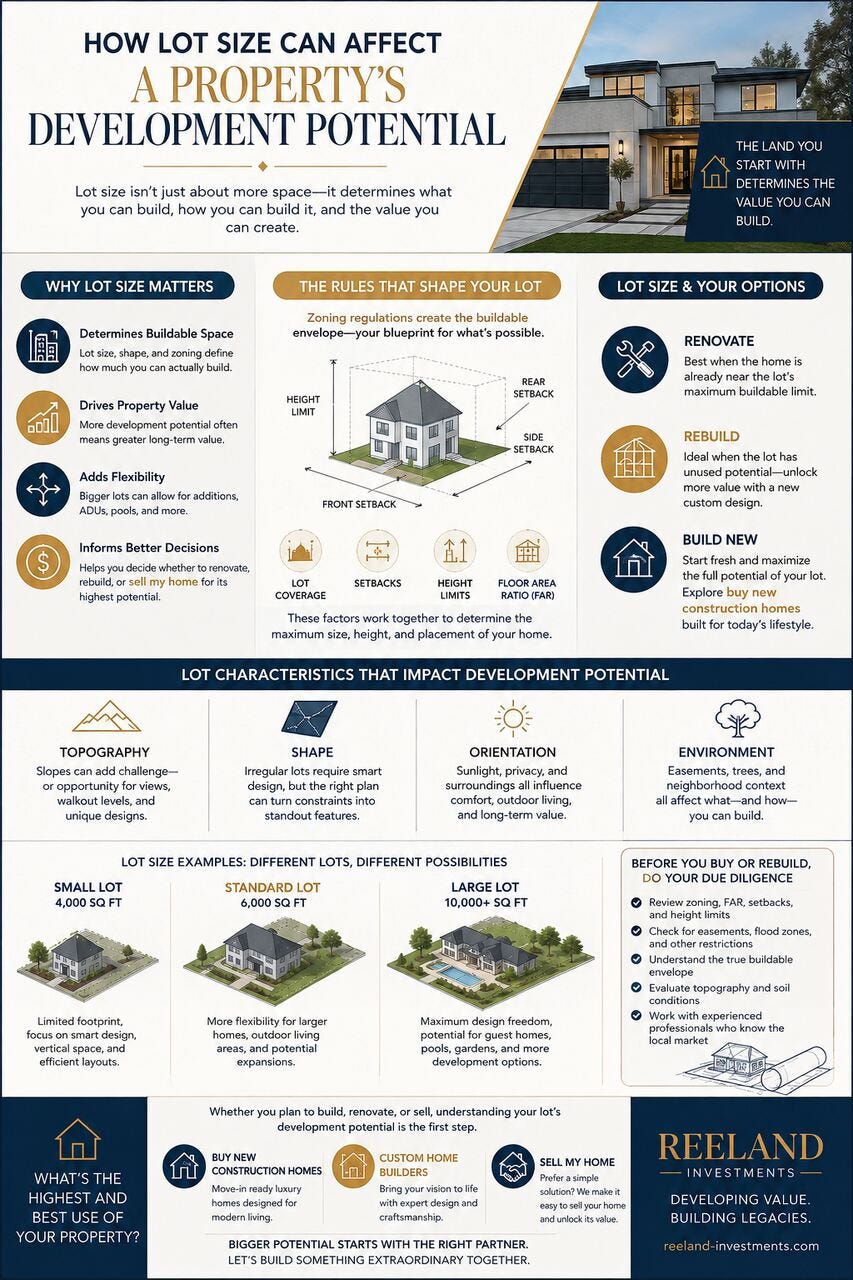
Lot size isn’t just a number on a listing sheet. It determines what you can legally build, how much flexibility you have in design, whether you can add square footage or a second unit, and ultimately, how much value a development project can create. Whether you’re a homeowner exploring your options, an investor evaluating a potential acquisition, or someone weighing whether to renovate or rebuild, understanding how lot size influences development potential can change the entire direction of a project.

Why Lot Size Matters More Than Most People Realize

Why Lot Size Matters More Than Most People Realize — Reeland Investments

At first glance, a bigger lot might just seem like more yard space. In reality, lot size interacts with zoning codes, setback requirements, height limits, and lot coverage ratios to determine the maximum buildable footprint of a home. Two lots that are the same square footage can have wildly different development potential depending on their shape, orientation, topography, and the zoning designation attached to them.

This is why experienced developers rarely evaluate a property based on the existing structure alone. The real question is: what does the land allow, and how close is the current use to maximizing that potential? A modest, dated home sitting on an underbuilt lot can represent far more opportunity than a larger, newer home already built out to its legal limit.

Zoning and Setbacks: The Rules That Shape the Lot

Zoning and Setbacks The Rules That Shape the Lot — Reeland Investments

Every municipality has zoning ordinances that dictate how a lot can be used. These typically define:

  • Lot coverage is the percentage of the lot that a structure is allowed to occupy.
  • Setbacks required distances between the structure and the property lines (front, side, and rear).
  • Height limits how tall a structure can be, often tied to the number of stories permitted.
  • Floor Area Ratio (FAR) is the maximum allowable building square footage relative to the lot size.

Together, these rules create what’s often called the buildable envelope, the three-dimensional space within which a structure can legally exist. A larger lot generally creates a larger buildable envelope, but that isn’t guaranteed. An oddly shaped lot, a lot on a slope, or a lot with wide setback requirements can shrink the usable building area significantly, even if the total square footage looks generous on paper.

This is one of the first things a development team analyzes before making an offer on land. It’s not enough to know the lot is, say, 6,000 square feet; you need to know how much of that 6,000 square feet can actually be built on, and in what configuration.

Lot Size and Renovation vs. Rebuild Decisions

Lot Size and Renovation vs. Rebuild Decisions — Reeland Investments

Lot size plays a major role in one of the most common questions property owners face: Should I renovate my existing home, or is it smarter to start over?

If a home sits on a lot that still has significant unused development capacity, meaning the current structure is well below the maximum allowable square footage, a rebuild or major expansion often makes more financial sense than a renovation. You’re essentially leaving value on the table by not using the full potential of the land.

On the other hand, if a home is already built close to the legal maximum for its lot, a thoughtful renovation may be the better path, since a full rebuild wouldn’t meaningfully increase the square footage anyway. In these cases, the value creation comes from improving layout, finishes, and functionality rather than adding size.

This is why lot size analysis should come before any decision about renovating, expanding, or rebuilding. Without it, owners risk either underinvesting in a property with real upside or overinvesting in a rebuild that won’t produce meaningfully more space than what’s already there.

Larger Lots and the Case for New Construction

Larger Lots and the Case for New Construction — Reeland Investments

For lots with substantial unused capacity, new construction often unlocks the most value. Building from the ground up allows for a layout designed specifically to take advantage of the lot’s full dimensions, orientation, and views rather than working around the constraints of an existing footprint.

This is also where the option to buy new construction homes becomes relevant for buyers who want a move-in-ready property built to current standards, without taking on renovation risk themselves. Larger, well-positioned lots tend to support these kinds of ground-up builds because they offer enough buildable area to justify the cost of demolition and new development, while still delivering strong return potential once the home is complete.

Lot size also affects the kind of home that makes sense to build. A narrow, deep lot might support a two- or three-story design with a smaller footprint, while a wide, shallow lot might be better suited to a single-story or sprawling layout. The lot dictates the architecture, not the other way around.

Smaller or Constrained Lots: Different Strategy, Not Necessarily Less Potential

It’s a common misconception that smaller lots automatically mean less development potential. In many desirable, land-constrained markets, smaller lots can still command strong value, especially when zoning allows for creative use of vertical space, accessory dwelling units, or efficient modern layouts that maximize every square foot.

The strategy simply shifts. Instead of focusing on expanding the footprint, development on a smaller lot often focuses on smart design, quality finishes, and efficient use of height and interior space. This is where working with custom home builders Manhattan Beach matters most. A generic floor plan rarely takes full advantage of a constrained lot’s specific dimensions and quirks, but a custom-designed home can be tailored precisely to maximize what the lot allows.

Topography, Shape, and Orientation

Topography, Shape, and Orientation — Reeland Investments

Beyond raw square footage, several physical characteristics of a lot influence its development potential just as much as its size:

Topography: Sloped lots can add construction cost and complexity, but they can also unlock features like walkout lower levels, elevated views, or multi-level designs that flat lots simply can’t offer.

Shape: Irregular or narrow lots can limit design flexibility, but they can also create unique architectural opportunities for developers who know how to work within unconventional dimensions.

Orientation: A lot’s orientation relative to the sun, street, and surrounding properties affects natural light, privacy, and outdoor living space, all of which influence buyer appeal and long-term value.

An experienced development team evaluates all of these factors together with raw lot size, because size alone doesn’t tell the full story of what a piece of land can become.

How Lot Size Affects Long-Term Property Value

From an investment standpoint, lot size is one of the most durable drivers of value. Structures depreciate and go out of style; land, especially in desirable areas, tends to hold or appreciate over time. This is why two nearly identical homes can have very different long-term appreciation potential if one sits on a larger, more developable lot than the other.

For owners considering their options, this raises an important question: is the highest and best use of the property to hold and improve it, or to sell it and let a development team unlock its potential? For property owners who’d rather not take on the complexity of construction themselves, choosing to sell my home to a firm that understands zoning, buildable envelopes, and design potential can be a more straightforward path to capturing that value, without managing permits, contractors, and timelines directly.

What to Look at Before Buying Land or a Teardown

If you’re evaluating a lot with development in mind, whether to build your own custom home or as an investment, a few due diligence steps matter more than most buyers realize:

  • Pull the zoning designation and understand the FAR, setbacks, and height limits that apply.
  • Check for lot-specific restrictions, such as easements, flood zones, or hillside ordinances.
  • Understand the true buildable envelope, not just the raw lot dimensions.
  • Factor in soil and topography, which can significantly affect construction costs.
  • Talk to a team with local development experience who can translate zoning code into a realistic design and budget.

Skipping this analysis is one of the most common and costly mistakes buyers make when purchasing land or a teardown property. A lot that looks like a great deal on paper can turn into a much smaller opportunity once the actual buildable area is calculated.

The Bottom Line

Lot size is one of the most underappreciated factors in real estate development, yet it quietly determines what’s possible for almost every project, from a modest renovation to a ground-up luxury build. Understanding zoning limits, buildable envelopes, topography, and shape gives owners, buyers, and investors a much clearer picture of a property’s true potential, well beyond what the existing structure suggests.

Whether the right move is renovating within an existing footprint, building new to take full advantage of an underused lot, or selling to a team equipped to unlock that potential, the decision should always start with a clear understanding of what the land itself allows.

Frequently Asked Questions

Does a bigger lot always mean more development potential?

Not necessarily. A larger lot generally allows for more buildable square footage, but factors like setbacks, shape, topography, and zoning restrictions can significantly reduce the actual usable building area, regardless of the lot’s total size.

How do I find out what I’m allowed to build on my lot?

Local zoning ordinances outline lot coverage limits, setback requirements, height restrictions, and floor area ratios. Checking with your local planning or building department, or working with a development team familiar with local codes, is the most reliable way to determine your buildable envelope.

Is it better to renovate or rebuild based on lot size?

It depends on how much of the lot’s development potential the existing structure is already using. If a home is far below the maximum allowable square footage, a rebuild or expansion may create more value. If the home is already close to that limit, renovation often makes more financial sense.

Can a small lot still be a good investment?

Yes. Smaller lots in desirable areas can hold strong value, especially with efficient, well-designed construction that makes the most of limited space. The strategy shifts from maximizing footprint to maximizing design and finish quality.

What’s the first step if I want to sell a property with development potential?

Start by understanding the lot’s zoning and buildable capacity, since this directly affects what a buyer or developer would be willing to pay. From there, connecting with a team experienced in evaluating land and development potential can help you understand your options and get an accurate sense of value.

Monday, August 3, 2026

Teardown vs. Turnkey: What Actually Drives Home Value

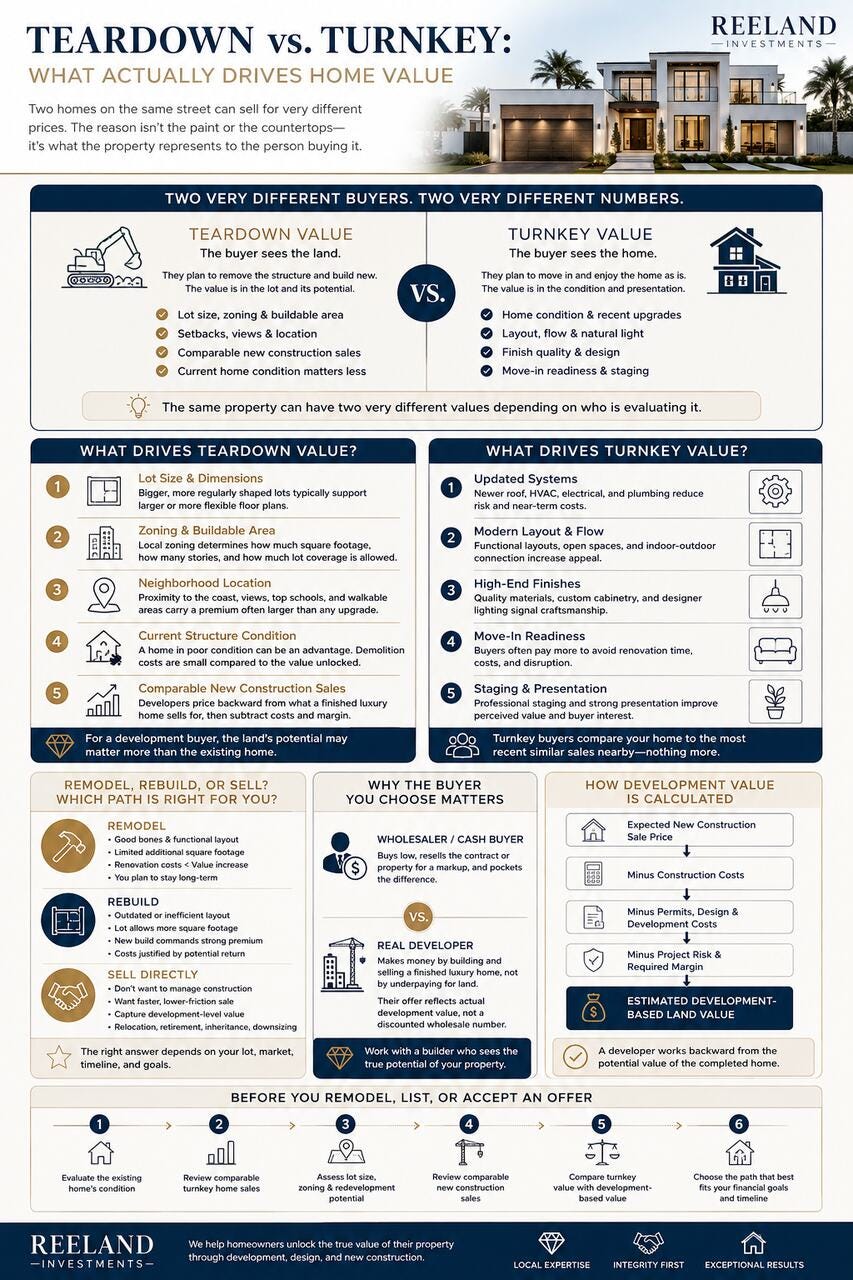
 When homeowners start thinking about selling, they almost always ask the same question first: “What’s my house worth?” It feels like a simple question. It isn’t. Two homes on the same street, built the same year, with nearly identical square footage, can sell for wildly different prices and the reason usually has nothing to do with paint color or countertops. It has to do with what the property represents to the person buying it.

Teardown vs. Turnkey What Actually Drives Home Value

That’s the real divide in today’s high-end real estate market: teardown value versus turnkey value. Understanding which one applies to your property and why is the single most important factor in deciding how, when, and to whom you should sell.

Two Very Different Buyers, Two Very Different Numbers

Two Very Different Buyers, Two Very Different Numbers - Reeland Investments

Every property attracts one of two types of buyers, and each type is doing completely different math.

The turnkey buyer is purchasing a lifestyle. They’re evaluating finishes, layout, natural light, curb appeal, and how quickly they can move in without lifting a hammer. Their offer is anchored to comparable sales of similarly finished homes what real estate agents call “comps.” If your home is updated, well-maintained, and move-in ready, this is the buyer pool you’re competing in, and your home’s condition directly determines your ceiling.

The development buyer isn’t evaluating your home at all. They’re evaluating your lot. Square footage of the existing structure, kitchen finishes, even the age of the roof none of it matters much, because the plan is to remove the structure and build something new. What matters instead is lot size, zoning, setbacks, buildable square footage, views, and location. A worn-down 1962 ranch house can be worth more to this buyer than a beautifully renovated home next door, simply because of what the land underneath it can become.

The mistake many homeowners make is pricing their property or evaluating an offer using only one of these lenses. If you own an older home on a desirable lot and you only compare yourself to other “as-is” fixer sales, you’re almost certainly leaving money on the table. If you own a dated home and assume a full remodel is the only path to unlocking value, you may be ignoring a faster, cleaner option sitting in plain sight: selling directly to a developer who sees what you don’t.

What Actually Drives “Teardown” Value

What Actually Drives Teardown Value - Reeland Investments

Teardown value isn’t about the house at all it’s about everything the house is sitting on top of. When a developer evaluates a property for redevelopment, they’re running through a fairly specific checklist:

Lot size and dimensions: Bigger, more regularly shaped lots typically support larger or more flexible floor plans.

Zoning and buildable area: Local zoning determines how much square footage, how many stories, and how much lot coverage is allowed. Two identically sized lots can have very different development potential depending on setback requirements and height limits.

Location within the neighborhood: Proximity to the coast, a view corridor, a top-rated school, or a walkable downtown core all carry a premium often a larger one than any interior upgrade could add.

Current structure condition: Ironically, a home in poor condition can be an advantage here. There’s little sunk cost being “wasted” in a teardown, and demolition costs are relatively minor compared to the value being unlocked.

Comparable new construction sales: Developers price backward from what a finished luxury home sells for in that specific micro-neighborhood, then subtract construction costs and margin to arrive at a land value.

This is why a homeowner will sometimes hear, almost in disbelief, that their “outdated” home is worth more than they expected. The house isn’t being valued. The dirt is.

What Actually Drives “Turnkey” Value

What Actually Drives Turnkey Value - Reeland Investments

Turnkey value works in the opposite direction it’s built almost entirely on the condition and presentation of the existing structure.

  • Recent renovations and updated systems (roof, HVAC, electrical, plumbing) reduce a buyer’s perceived risk and near-term costs.
  • Modern layout and flow matter more than raw square footage. Open-concept living, primary suites with private access, and functional indoor-outdoor connection all command a premium in luxury markets.
  • Finish quality stone surfaces, custom cabinetry, designer lighting signals craftsmanship and justifies a higher price per square foot.
  • Move-in readiness removes friction. A buyer who doesn’t have to manage a renovation project is often willing to pay for that convenience.
  • Staging and presentation genuinely affect perceived value, even though they don’t change the underlying structure.

A turnkey buyer is comparing your home to the last five similar homes that sold nearby full stop. There’s no discount for land potential and no premium for it either, because that buyer isn’t planning to build anything.

The Gap Between the Two and Why It’s Often Bigger Than Homeowners Expect

The Gap Between the Two and Why It's Often Bigger Than Homeowners Expect - Reeland Investments

Here’s where it gets interesting. On any given lot, the turnkey value and the teardown value are rarely the same number, and the gap between them can be substantial sometimes the difference between selling for a comfortable profit and leaving six or seven figures on the table.

Consider an older home in a high-demand coastal or hillside neighborhood. On the open market, priced against other dated homes, it might attract offers in a fairly narrow, unremarkable range. But priced against what a developer could build and sell that same lot for as a brand-new luxury residence, the underlying land value can be dramatically higher. The home itself is almost incidental to that number.

This is exactly why so many homeowners are surprised pleasantly when they get a development-based evaluation instead of a standard listing appraisal. It’s not a trick or a sales tactic. It’s simply a different, and often more accurate, way of measuring what a property is actually worth in a supply-constrained luxury market.

Rebuild, Remodel, or Sell? A Practical Way to Decide

Rebuild, Remodel, or Sell A Practical Way to Decide - Reeland Investments

If you’re sitting on an older property, you generally have three paths, and each makes sense under different conditions.

Remodel makes sense when the existing structure has good bones, the lot doesn’t support significantly more square footage than what’s already built, you plan to stay in the home long-term, and renovation costs stay well below the home’s post-renovation value.

Rebuild makes sense when the current floor plan is inefficient or outdated, the lot allows meaningfully more square footage than what exists today, and construction costs are clearly offset by the resale premium a new home would command.

Sell directly makes sense when you don’t want to manage a construction project yourself, you’d rather capture development-level value without the time, risk, and capital outlay of building, or your circumstances relocation, retirement, an inherited property, downsizing call for a faster, lower-friction transition.

None of these is universally “right.” The right answer depends on your lot, your local market, your timeline, and your appetite for managing a project. But too many homeowners only ever consider two of these three options, usually remodel or a standard sale, without ever getting a proper development-based evaluation to see what the third path is actually worth.

Why the Buyer You Choose Matters As Much As the Price

Why the Buyer You Choose Matters As Much As the Price - Reeland Investments

If you determine your property leans toward teardown value, the next decision is just as important as the number itself: who you sell to.

A traditional cash-buyer or wholesaler model is built on the same principle as a middleman in any industry buy low, resell the contract or the property to someone else for a markup, and pocket the difference. That structure depends on you accepting less than the property is worth, because the wholesaler isn’t building anything; they’re flipping the deal itself.

A genuine developer operates differently, because the economics are different. A real luxury home builder makes money by constructing and selling a finished home, not by underpaying for the land. That means the offer can and should reflect actual development value, not a discounted wholesale number. If you’re comparing offers and want to sell my house fast Manhattan Beach without giving up the value your lot actually carries, the source of the offer matters just as much as the dollar figure attached to it.

This is also where new construction homes come back into the picture, even for a seller. Every finished new construction home in your neighborhood is a data point. It tells you, concretely, what a developer is able to sell a home for once your lot has been transformed which is exactly the number a legitimate developer should be working backward from when they make you an offer, rather than lowballing based on the current condition of your house.

The Bottom Line

Teardown value and turnkey value aren’t competing theories they’re two different lenses that apply to two different kinds of properties, and sometimes to the very same property depending on who’s looking at it. The homeowners who get the best outcomes are the ones who understand which lens applies to them before they list, remodel, or accept an offer.

If your home is updated, modern, and move-in ready, you’re playing the turnkey game, and your focus should be on presentation and timing relative to comparable sales. If you own an older home on a desirable lot, it’s worth getting a development-based evaluation before assuming a standard sale or a full renovation is your only option. The gap between what your home is worth “as-is” and what your land is worth to the right buyer can be the most financially significant number in the entire decision.

Frequently Asked Questions

How do I know if my home is worth more as a teardown or as a turnkey sale?

The clearest signal is the relationship between your lot’s development potential and your home’s current condition. If your lot allows for significantly more square footage than what’s currently built, or sits in a location where new construction commands a strong premium, it’s worth getting a development-based evaluation alongside a traditional market comparison before deciding.

Will a developer really pay more than a standard cash buyer?

It depends on the buyer. A wholesaler’s business model depends on underpaying for your property so they can resell the contract for a markup. A legitimate developer’s model is based on construction and resale, so a fair offer should be built from land and development value not a discounted, below-market number.

Do I need to renovate my home before selling it for its land value?

Generally, no. If a buyer intends to redevelop the site, the condition of the existing structure has little bearing on the offer, since the home will likely be removed. Spending money on cosmetic updates before a teardown sale is usually unnecessary.

Is rebuilding always a better investment than remodeling?

Not always. Rebuilding tends to make more financial sense when the lot supports meaningfully more square footage than currently exists and construction costs are clearly offset by the resulting resale value. If your lot is already built close to its maximum allowable size, a well-planned remodel may be the smarter move.

How quickly can I sell if my property has development potential?

Timelines vary by buyer, but a direct sale to a developer is often faster than a traditional listing, since there’s no staging, showings, or financing contingencies involved. Some homeowners are able to close in a matter of weeks through a private, direct transaction, while others prefer a longer timeline to align with a move or other life event a serious developer should be able to work with either.

Sell Your Manhattan Beach Home Without Paying Agent Fees

  Manhattan Beach is one of the strongest seller's markets in Los Angeles County, which makes it easy to assume a traditional agent-list...